
Mechanical
RoboSub 2026 > Mechanical

Overview
Much of Onyx is based on Græy (our 2020-2025 AUV), and much of Græy is based on Orange (our 2019-2020 AUV), so we continued to use 80/20 extrusions for the frame's base construction. Using 80/20 extrusions provides us with greater modularity in constructing our AUVs. While 80/20 extrusions may not be as compact as alternate options, like CNC waterjet parts, their quick assembly and cost efficiency allowed us to deliver within a tight schedule. Furthermore, this system’s modularity allowed us to rapidly make crucial modifications. For example, we fixed an unequally distributed buoyancy on Græy by shifting the positions of its two enclosures. With the 80/20 build system, we can use our manufacturing method of 3D printing to create accurately and properly toleranced parts that interface well.
Onyx
Torpedo Launcher

The torpedo launcher is powered by a single Gobilda torque servo encased in a Blue Trail Engineering Underwater SER-2000 Servo Enclosure. The servo turns a pair of offset cams, which open the sear gates and release the stored energy of an extension spring into the torpedos. Magnets embedded in the torpedoes and the torpedo tubes prevent premature deployment of the torpedoes.
Gripper
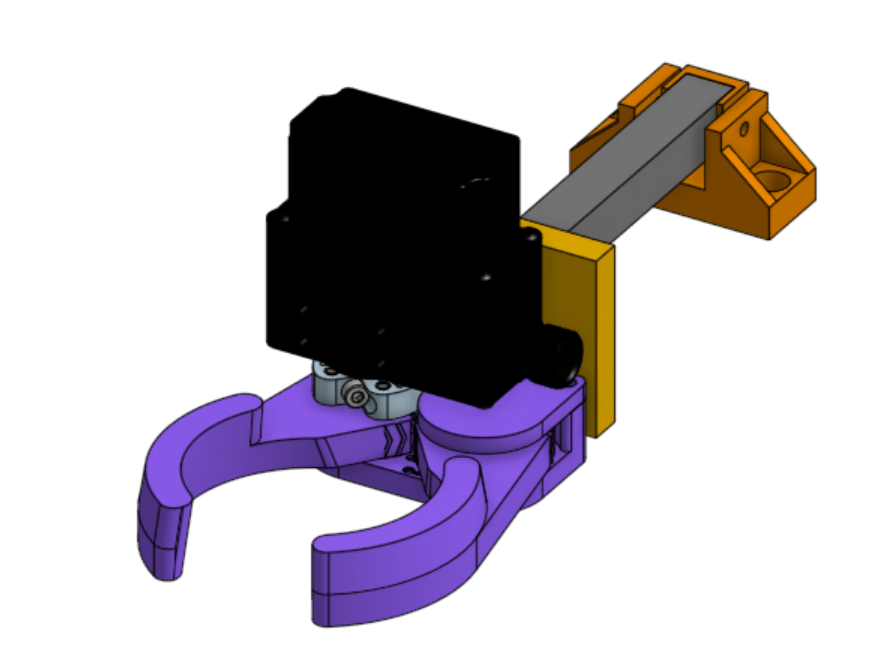
The team refined an open-source gripper design for functionality and strength by developing specific failure points and sustaining the main structure. We upgraded from last year’s straight-edge gear to herringbone, eliminating backlash issues. We also use the Blue Trail Engineering Underwater SER-2000 Servo Enclosure, so the gripper can function underwater.
Marker Dropper

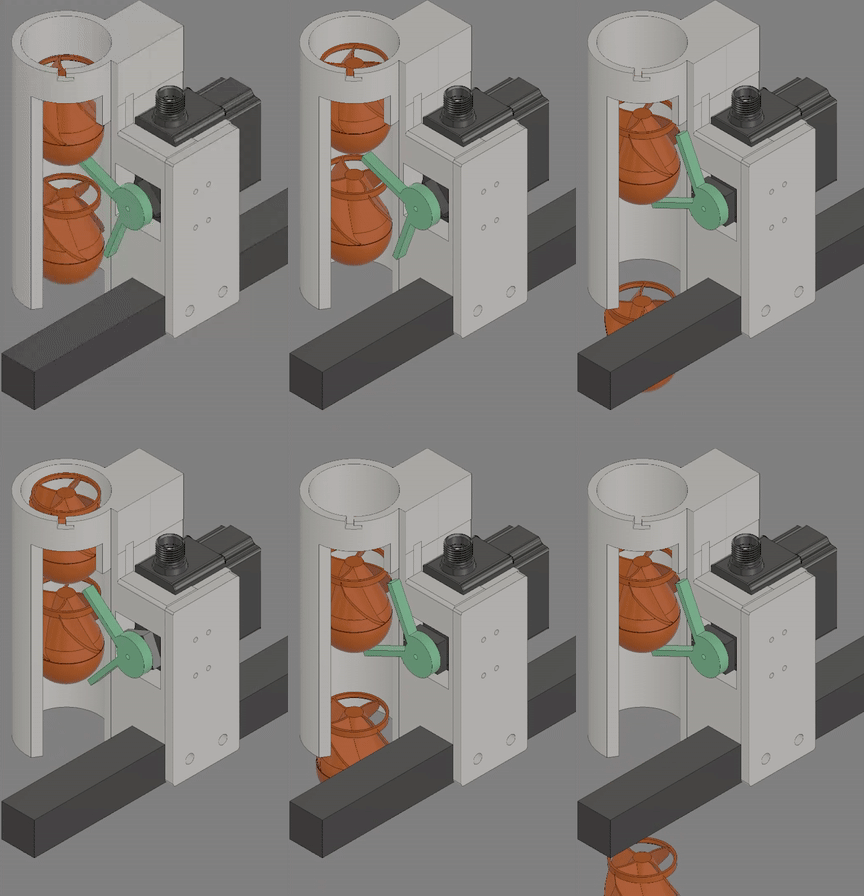
We began exploring different design options for the marker dropper by creating a trade study of different designs. Doing so allowed us to rank each design's attributes and select the most optimal design to go with. Our requirements for the marker dropper were to be able to drop two markers separately with only one servo while reducing the footprint as much as possible. We went with the Kyutech Kyubic design due to its weight, minimal size, fabrication cost, and reliability. Our first design implemented a 2000 Series Dual Mode Servo, a control arm, and a barrel that holds two spherical markers.
Our design needs to function underwater, so we used the Blue Trail Engineering Underwater SER-2000 Servo Enclosure. We used 3D printing to complete rapid prototyping initiatives to iterate and improve our design. We created dry and water unit tests using Arduino for performance verification.
DVL Enclosure

The DVL (Doppler Velocity Logger) was a late addition that was provided by Alan Kenny and his professional engineering team at Kenautics Inc. around March 2023, nearly 2 months before the competition. The team explored manufacturing feasibility as well as implemented simulation analysis to reduce risk and verify our design assumptions.